


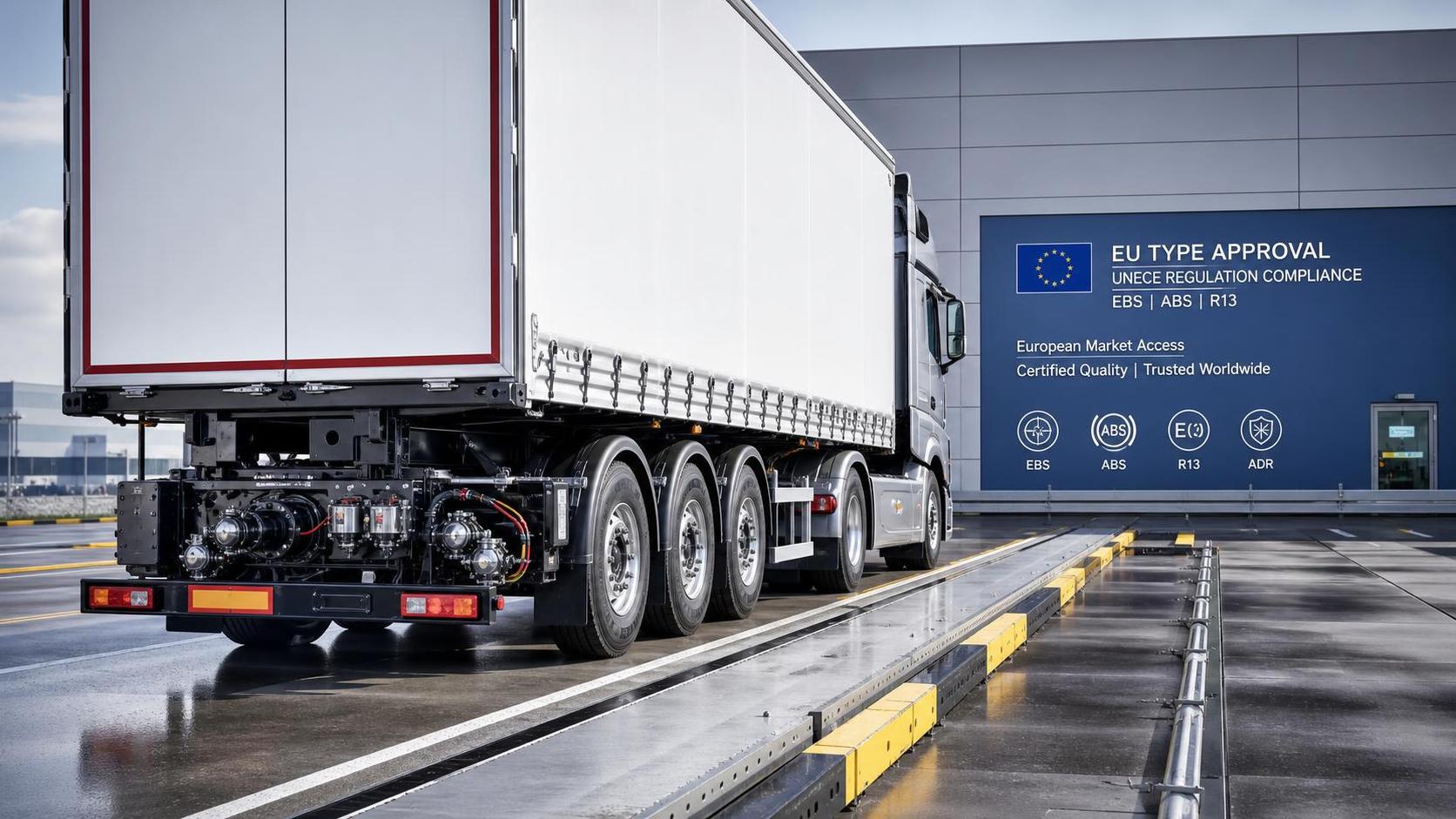
On August 9, 2026, a new EU braking compliance requirement for semi-trailers moved from notice to immediate market access condition. According to the amendment published in the Official Journal of the European Union on August 8, all newly certified semi-trailers must be equipped with a dual-circuit electronically controlled ABS compliant with ECE R13-H and must obtain type approval through a designated technical service body. For Chinese semi-trailer manufacturers and export-facing supply chain participants, this is worth close attention because the rule is tied directly to E/E-mark registration and customs clearance.
What the amendment now requires
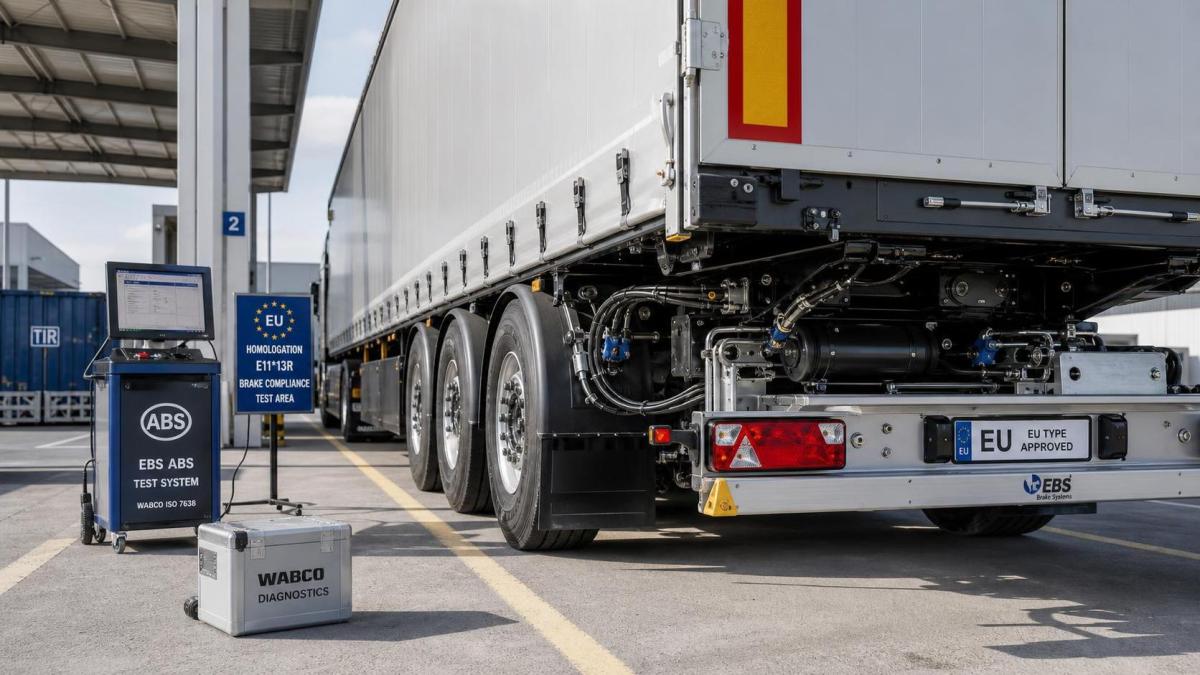
The confirmed change is tied to UN ECE Regulation No. 13-H, Amendment 5, published in the OJEU on August 8, 2026 and taking effect on August 9, 2026. From that date, all newly certified semi-trailers are required to use a dual-circuit electronically controlled anti-lock braking system that meets ECE R13-H.
The requirement is not limited to product configuration alone. The affected vehicles must also pass type approval through a designated technical service institution. Based on the information provided, vehicles that do not obtain the required certification will be unable to complete E/E-mark registration and customs clearance for entry into the EU market.
Where the pressure will appear first
Export manufacturers face an immediate certification gate
For semi-trailer manufacturers shipping to Europe, the direct impact is on market entry. The rule affects newly certified vehicles, which means compliance now sits at the point where technical configuration and regulatory approval meet. From an industry perspective, the issue is not only whether a trailer has ABS, but whether the braking system and its approval path satisfy the new ECE R13-H requirement in a form accepted for EU registration and clearance.
Component and system sourcing becomes more sensitive
Suppliers involved in braking system configuration may also feel the effect through specification alignment. Analysis shows that when dual-circuit electronically controlled ABS becomes a formal condition for new certification, sourcing decisions, technical documentation, and system matching are likely to receive closer scrutiny in export programs tied to the EU market.
Trade and delivery operations may be affected by paperwork readiness
For export traders, logistics coordinators, and customs-related service providers, the practical pressure point is documentation and approval status. Observably, the rule matters not only at the design stage but also in shipment execution, because a vehicle without the required approval cannot complete E/E-mark registration and customs clearance according to the provided information.
What companies should watch now
Separate technical compliance from sales assumptions
What deserves closer attention is the distinction between being configured for a market and being formally certifiable for that market. A trailer intended for EU export may still face access barriers if its braking system arrangement and type approval status are not aligned with the new requirement.
Review affected product pipelines and certification timing
Companies with semi-trailer models aimed at the EU should pay attention to which products fall under new certification activity after August 9, 2026. In practice, the timing of certification, document preparation, and coordination with designated technical service bodies may become more important than before.
Check supplier documents and approval support materials
For manufacturers and procurement teams, it is reasonable to focus on whether braking system suppliers can support the required approval process with complete and consistent technical materials. Analysis shows that supplier qualification, supporting documents, and coordination efficiency may become operational issues once compliance is tested through formal approval rather than commercial declaration.
Prepare customer communication around lead time and deliverability
Export teams should also monitor how the rule may affect delivery commitments tied to EU-bound orders. Where certification status is still being arranged, customer communication, shipment planning, and contingency preparation deserve attention, especially where registration and customs procedures depend on completed approval.
How this should be read at this stage
Analysis shows that this is more than a routine technical update. It acts as a clear compliance threshold for newly certified semi-trailers entering the EU market. At the same time, it is more appropriate to understand this as a regulatory access signal with immediate practical consequences, rather than as a full picture of long-term market restructuring. The confirmed fact is the new requirement and its link to certification and clearance; broader commercial outcomes still need continued observation.
From an industry perspective, the development matters because it brings braking system configuration, third-party approval, and export execution into one compliance chain. That combination tends to shift attention from product claims alone to approval readiness and document integrity.
The near-term takeaway for the market
The immediate significance of this update is straightforward: for newly certified semi-trailers targeting the EU, dual-circuit ECE R13-H-compliant ABS and type approval are now part of the access baseline from August 9, 2026. For industry participants, the more balanced reading is that this is a short-term operational change with longer-term signaling value. It does not by itself define all future trade outcomes, but it does make compliance preparation and certification coordination a more visible part of EU export execution.
Basis of this report and points to keep verifying
This article is based on the user-provided news title, event date, and event summary. For this type of development, commonly relevant source categories include official notices, standard or regulatory documents, company disclosures, industry association updates, and reporting by authoritative trade media.
No specific official source link was provided in the input, so the exact official link should continue to be verified. Observably, the next points worth following are whether any further official clarification appears around implementation wording, certification practice, or related compliance procedures connected to E/E-mark registration and customs clearance.
By clicking 'Allow All', you agree to the storage of cookies on your device to enhance site navigation, analyze site usage and assist with our marketing efforts. Coo Cookie Notice
Leave a message and we'll get back to you soon.